Understanding Sizing Standards: A Guide to Oversized Mattresses and Their Regional Variations
This guide explores common oversized mattress sizes (king, California king, split models) and how sizing standards differ by region. It helps readers choose the right dimensions for their space, bed frames, and sleep preferences.
Published September 26, 2026
A Sleepful Geography: The Landscape of Size
Sleep is a language spoken in inches as much as in breaths. The domain extralargemattress.com arrives at a timely intersection of comfort, space, and standardization. When we speak of oversized mattresses—the king, the California king, the split variants that tease apart couples who sleep in parallel universes—the frame of reference is not merely a bed’s width. It is a human measure: the room that cradles it, the foundation that bears it, and the rhythm by which two bodies may share a night without a whispered compromise.
The terms “king” and “California king” are universal shorthand, yet their exact dimensions can drift between brands, regions, and even individual retailers. This article unpacks those drift lines, offering a navigable map for shoppers who might cross borders in pursuit of better sleep, or who must measure a room before a decision about a bed frame or a base is made.
Key Mattress Sizes and What They Really Mean
The classic large sizes in the United States are the King and the California King. The King typically measures 76 inches wide by 80 inches long (193 cm by 203 cm). The California King is narrower and longer, commonly 72 inches wide by 84 inches long (183 cm by 213 cm). In practical terms, that means a California King accommodates rooms where depth is more abundant than width, offering a long, narrow horizon for sleepers who desire space along the length of the bed.
Beyond these standard sizes, there are variations that appear in regional markets and specialized retailers. Split King beds—two separate twinXL mattresses placed side by side—offer individual customization for couples who value independent mattresses, mobility, or distinct support systems. The split design can simplify fitting a large bed into rooms with doors, stairways, or awkward alcoves, while still delivering a shared sleeping surface.
It is important to recognize sizing differences by region. European and Asian markets, for example, may maintain slightly different standard dimensions, or may offer a wider array of custom-length options. When shopping across brands or crossing from one country to another, a careful verification of actual measurements is essential. A mattress’s labeled size is not a guaranteed standard; measurements matter for frame compatibility, sheets, and the transition between sleep ergonomics and architectural constraints.
Regional Variations: How Standards Diverge
Regional variation is not a mere footnote; it shapes how beds fit into rooms and how sleep benefits are distributed. In North America, the standard King and California King sizes have become largely consistent across major brands, but differences can arise in overall mattress thickness, edge-to-edge dimensions, and the depth of mattress toppers and protectors. In Europe, the bed landscape is perhaps more fragmented, with a greater willingness to offer a wider range of sizes that align with European bed frames and slatted foundations.
In Asia, you may encounter combinations of regional bed sizes or the more frequent availability of customizable lengths. Understanding these regional variations is not a curiosity; it is a practical necessity for interior designers, sleep researchers, and shoppers who want to avoid a mismatch between a frame, a headboard, and the bed they intend to live with.
The central imperative is clarity: always verify the actual dimensions, and, when possible, confirm the fit with the retailer or manufacturer ahead of purchase. The last thing anyone wants is a beautiful mattress that cannot be mounted on their chosen frame or slipped into the intended room because a couple of inches were misread or misremembered.
Practical Tips: Measuring Rooms, Choosing Bed Dimensions, and Verifying Measurements
- Measure your room with a human eye and a tape measure. Start with door width, then consider the path to the bed—will you need to pivot around furniture? A bed requires roughly 24 inches (60 cm) of clearance on each side for easy bed-making and movement around the space, though this can vary depending on personal style and room layout.
- Account for space around the bed. A standard room should consider at least 2 to 3 feet of walking space around the bed to preserve flow and accessibility, especially in master suites and guest spaces. For larger mattress sizes, you may need to recalibrate nightstands, seating, and storage to preserve balance and proportion.
- Choose frame compatibility with the mattress size. If you’re selecting a King or California King, verify that your bed frame, foundations, and slat systems align with the weight and footprint of the mattress. Split models can offer modular flexibility, but they require compatible frames and bed rails designed for two separate units.
- Consider bed depth and topper compatibility. Oversized mattresses often ride higher or deeper depending on toppers, protectors, and foundation types. Ensure that your sheets, protectors, and mattress pads will fit a deeper or broader unit without creating a tight squeeze at the sides or foot of the bed.
- Regionally tailored measurements matter. If your shopping journey will cross borders or brands, carry a notebook of measurements: inches, centimeters, and the exact depth of your chosen mattress, protector, and sheets. Cross-check product spec sheets or contact customer service to confirm exact dimensions.
Affect on Sleep Ergonomics and Comfort
The size of a mattress has direct implications for sleep ergonomics. Larger surfaces allow for more varied sleeping positions, reduce the friction of motion transfer, and can facilitate a more natural spinal alignment when paired with appropriate toppers and pillows. Yet, bigger does not automatically mean better if the room cannot support the footprint or if the sleeper’s routine and preferences demand a more compact, intimate space.
For couples, a larger bed can dramatically reduce wakeful moments caused by partner movement, but only if the underlying structure—foam or spring layers, edge support, and motion isolation—works in concert with the extra space. In excess, a mattress that is too large for its room can feel isolating, a private island with no obvious paths of escape or social energy in the morning.
Introducing the Arcadia Comfort Sleeper Mattress Pad
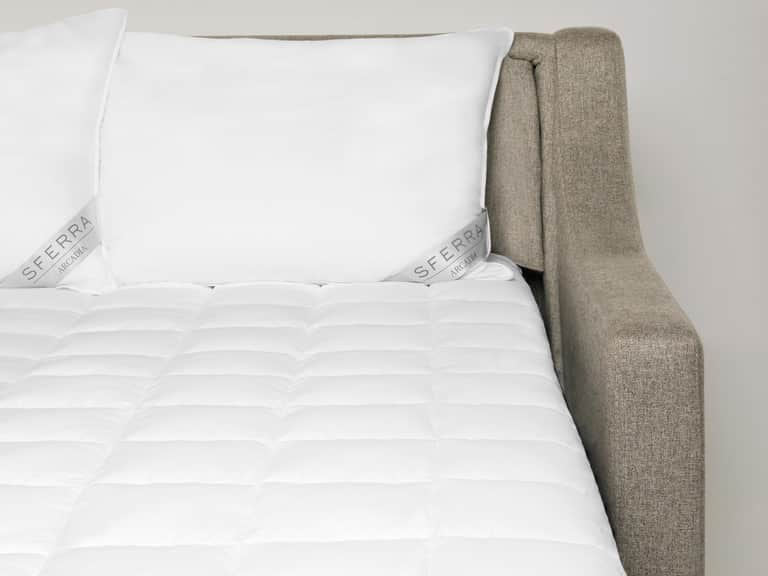
The Arcadia Comfort Sleeper Mattress Pad embodies a thoughtful approach to layering comfort without changing the bed’s fundamental structure. It sits atop a mattress, smoothing contours and distributing fill to enhance the bed’s surface without adding bulk that could disrupt sheet fit or frame clearance. The pad’s six-inch sewn-through box construction keeps fill evenly distributed, a practical feature for oversized beds that may demand uniform support across a larger surface area.
This is not merely a product listing; it is a case study in how bedding accessories can influence the perceived scale of comfort. The Arcadia pad uses pluma-fil down-alternative fill and a cotton sateen shell to provide a soft, breathable, and stable sleeping surface. When layered on top of an oversized mattress, the pad can contribute to a smoother transition from top sheet to sleeping surface and help manage temperature and feel across the entire bed.
Consider this pad within the broader ecosystem of oversized mattress configurations. It is a reminder that sleep ergonomics are rarely about one element alone; rather, they emerge from the careful curation of layers that work together—mattress core, toppers, pads, sheets, and protectors.
Brand: Sferra
Key features: 330TC cotton sateen, pluma-fil down-alternative, 6" box construction, elasticized sides for a snug fit on deep mattresses (up to 17" depth).
Size range: Twin to California King (availability varies by retailer).
Care, Maintenance, and Longevity
Oversized beds invite a cadence of care that respects their scale. Maintaining a bed of generous dimensions involves regular washing cycles for accessories, careful inspection of edge supports for toppers and pads, and mindful rotation of any mattress toppers to preserve even wear. A careful routine—draw the sheets, flip the toppers, vacuum the voids under the bed—helps to extend the life of the entire sleep system.
The Arcadia Comfort Sleeper Mattress Pad, for example, is designed for practical care: machine wash cold, tumble dry low, and avoid chlorine or fabric softeners. Its design anticipates everyday life—children, pets, or busy adults—without sacrificing the calm, tailored surface that an oversized mattress deserves.
Three Historical Echoes: Key Figures Across Time Periods
In the conversation about space, size, and sleep, voices from different eras offer resonance. Consider three figures whose ideas about space, comfort, and measurement illuminate our modern dialogues around oversized mattresses.
- David Hume (1711–1776): Though not a sleep scientist, Hume’s empiricism invites us to anchor mattress sizing in observable experience. In a matter-of-fact chamber, he might remind us to test a bed’s dimensions by the lived realities of knees, hips, and elbows in repose. For our purposes, his insistence on experiential validation reinforces why measuring a room and testing fit matters more than any label on a product.
- Florence Nightingale (1820–1910): A pioneer of modern hospital design, Nightingale would appreciate the bed as a critical site of patient recovery and comfort. Her emphasis on hygiene, space, and patient well-being translates beautifully into the domestic setting: larger beds can offer more breathing room for restful sleep, but only if the surrounding space, climate, and organization support that regeneration.
- Ludwig Mies van der Rohe (1886–1969): The architect of modern minimalism believed in clarity of space and rational proportions. In the realm of oversized mattresses, his philosophy would advocate for rooms where the bed’s footprint is integrated with the room’s lines, furniture rhythm, and light. A bed, to him, is not merely a sleeping surface; it is a space-defining element that should harmonize with the architecture around it.
Case Study: A Room with a King-Size View
Imagine a master suite where the bed becomes the room’s anchor—a King-size x 80 inches, sitting gracefully within a generous footprint. Nightstands flank the mattress like two quiet witnesses. The lamps cast warm halos, and the rug beneath the bed anchors the space with texture. A California King might elongate the room’s balance, inviting an extra step of morning stretch and the possibility of a small sitting area at the foot of the bed. In architectural terms, the space around the mattress becomes as important as the mattress itself.
In this hypothetical but plausible scenario, one might choose a split King or Split California King for a bedroom where two sleepers require different degrees of firmness or independent motion control. The bed’s components—frame, foundation, toppers, and padding—must work as a single symphony, ensuring comfort, durability, and a sense of roominess that does not overwhelm the surrounding interior.
Conclusion: The Quiet Power of Size Thoughtfully Considered
Oversized mattresses offer more than a broader sleep surface. They invite us to rethink how rooms are organized, how beds anchor the space, and how the choice of dimensions aligns with sleep quality and daily living. The sizing standards and regional variations are not bureaucratic impediments; they are the practical scaffolding that lets us dream in proper scale.
As you plan an upgrade or a new purchase, remember that the best sleep environment is not just a bigger bed but the right bed in the right space, paired with thoughtful accessories that contour to your body and your room’s rhythm. Whether you opt for a King, a California King, or a Split King to harmonize different sleep patterns, ensure your room’s architecture, lighting, and furniture choreography support your whole night—hour by hour, inch by inch.
References and Further Reading
For readers seeking deeper dives on regional variations and product specifics, consult retailer specifications, product sheets, and sizing charts across brands. The goal remains consistent: precise measurements, honest comparisons, and a sleep environment that fits your life as it is today, and adapts to the nights you dream of tomorrow.
Quick Glance: Size Guide (Common Oversized Mattress Sizes)
| Size | Dimensions (inches) | Dimensions (cm) |
|---|---|---|
| King | 76 x 80 | 193 x 203 |
| California King | 72 x 84 | 183 x 213 |
| Split King | Two x Twin XL: 38 x 80 each | Two x 97 x 203 each |
| Custom/Regional Variants | Varies | Varies |