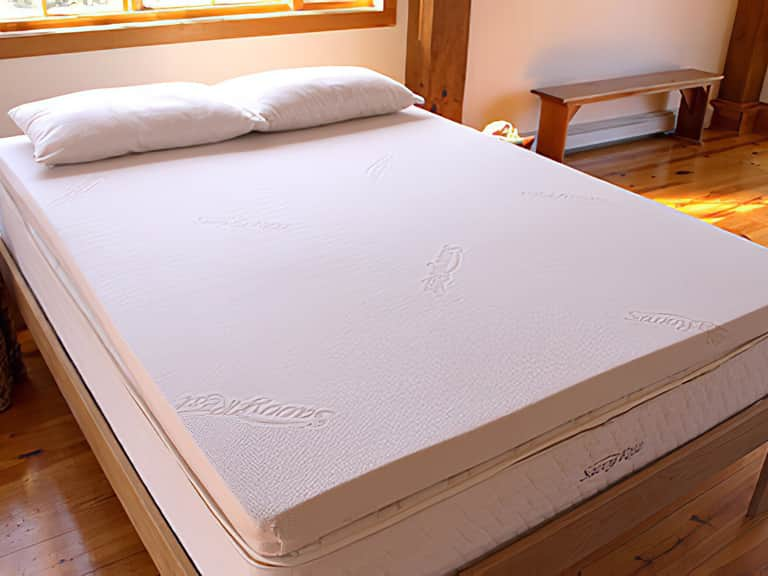
Bedroom planning · Mattress size · Natural latex
Planning Room Layouts for an Oversized Obasan Sleep Surface
A larger mattress can make a bedroom feel generous at night and unexpectedly difficult by day. Before choosing an oversized Obasan natural latex organic mattress, consider not only the dimensions of the bed but the entire journey it must take into the room—and the paths people will need to travel around it once it is there.
Published October 30, 2026
There is a moment in many bedroom plans when the bed grows in the imagination before it grows on paper. The room seems to have space for it. A king-size surface, perhaps a California king, or a custom configuration that gives two sleepers room to turn without negotiating the borderlands of a shared mattress. Then come the practical questions: Will the bed fit through the front door? Can it turn at the stair landing? Is there still room to open the wardrobe, reach the window, change the sheets, and walk to the other side without performing a small sidestep?
An oversized sleep setup is not simply a larger rectangle placed in a room. It is a change to the room’s circulation, its furniture arrangement, and sometimes the route by which the mattress arrives. Those details matter especially when considering a substantial natural latex mattress. An Obasan natural latex organic mattress may be part of a considered decision about materials and comfort, but the available space and the mattress’s exact dimensions must be confirmed before planning around it. Product configurations can vary; a familiar size label is not a substitute for a measurement.
The best preparation is unglamorous and wonderfully effective: measure the room, measure the route into it, draw a simple plan, and test the arrangement before committing. It is a little like rehearsing a piece of furniture’s arrival before the furniture knows it has been cast.
Start with the mattress, not the label
“King” sounds precise, but mattress names do not always settle every practical question. Standard dimensions differ by region, while custom and nonstandard sizes can differ from familiar retail measurements. Even within one category, a mattress, its cover, its foundation, and the bed frame may not share identical external dimensions. If an Obasan mattress is being considered in a particular size, ask for the exact length, width, depth, and any relevant construction details directly from the seller or manufacturer.
Write those numbers down. Then distinguish the sleeping surface from the footprint of the complete bed. A frame may extend beyond the mattress at the head, foot, or sides. A headboard can add depth; a platform with a substantial edge can add width. If a foundation or adjustable base is part of the setup, include its measurements, too. The room must accommodate the object as it will actually exist—not the most convenient version of it on a product page.
It can help to make a short specification sheet before choosing a layout:
- Mattress: confirmed width, length, and depth.
- Frame and base: outer dimensions, including any headboard or footboard.
- Access: whether the mattress can be carried flat, tilted, bent, or otherwise maneuvered as permitted by its construction.
- Bedding: sheet and protector dimensions, pocket depth, and availability in the chosen size.
- Room: wall-to-wall measurements, door locations, windows, closets, radiators, and other fixed features.
Confirm the maker’s handling instructions before assuming that a mattress can be folded or flexed. Natural latex is resilient, but resilience is not permission to treat a mattress as luggage. The way it is constructed, the materials around the core, and the manufacturer’s guidance all matter.
The room is more than four walls
A floor plan tends to flatter a bedroom. It shows the bed in clean lines, the dresser as a modest rectangle, and the doorway as an opening without a door attached. Real rooms are less polite. Doors swing; drawers project; closet doors need clearance. Window treatments occupy space. A radiator, a baseboard heater, or a sloped ceiling can make a seemingly available corner unsuitable. A mattress plan that ignores these interruptions may be accurate in the abstract and awkward every morning.
Measure the room at floor level, but also note features that affect use above the floor. Record where doors open and how far they swing. Measure the distance from the wall to the edge of a closet door when open. Note windowsills, low eaves, outlets, switches, heating elements, and anything that must remain reachable. If a room has alcoves or an irregular outline, measure each segment rather than relying on one length and one width.
Then consider the space people need around the bed. There is no single clearance that suits every room or household. The right amount depends on who uses the room, how the bed is made, what other furniture is present, and whether mobility needs call for additional room. A narrow route may be acceptable on the side of a rarely used guest bed; it may be exasperating when both partners need access each night. The goal is not to meet an imaginary universal number. It is to ensure that the planned arrangement works for its occupants.
Try to preserve a comfortable route from the bedroom entrance to the bed and onward to the closet, bathroom, or window. Think of the pathways as part of the room’s design rather than leftover strips between objects. If a person has to turn sideways to reach the wardrobe, or step over a bench to get to the far side of the mattress, the layout is already giving useful feedback.
Make a plan you can walk through
A simple floor plan can answer many questions before anything is delivered. Draw the room on graph paper or use a basic planning tool. Choose a scale—one square might represent six inches, for instance—and keep it consistent. Mark the walls, door swings, windows, closets, and fixed obstacles. Then make paper cutouts for the mattress and the other large furniture. If the frame’s footprint is larger than the mattress, make the cutout match the frame.
Move the bed shape around. Try the obvious position first, usually with the head against a solid wall, but do not assume it is the only sensible one. In some rooms, centering the bed on the longest wall produces better routes; in others, it blocks a window or leaves no useful space for bedside tables. A small shift can determine whether drawers open freely or whether the entrance feels like a corridor to a wall of bedding.
For a more physical test, mark the mattress and frame footprint on the floor with painter’s tape. Include the bedside tables and any dresser that will remain. Walk the intended routes. Open the doors and drawers. Stand where you would stand to make the bed. Reach for the lamps or outlets. The tape will not capture the feeling of a real mattress, but it reveals the geometry that a hopeful glance across the room often misses.
Test ordinary tasks, not only the dramatic ones. Can a person make the bed without climbing onto it? Is there space to change sheets at the far corners? Can a laundry basket pass between the bed and the door? If a nightstand is part of the plan, can its drawer open while someone is standing beside it? A bedroom is used in a thousand small motions; successful planning respects them.
Measure the route in
A mattress that fits the bedroom may still fail the journey. Before ordering, follow the delivery route from the building entrance to the bedroom. Measure door openings, hallways, staircases, landings, and tight turns. Include the available height beneath stair ceilings and note handrails, light fixtures, and other obstructions. In an apartment, check any building requirements for deliveries, lifts, service entrances, or scheduled access.
The useful measurement is not always the width of a doorway in isolation. A large item must turn through the opening, and the space on either side of the door affects the maneuver. A hallway that looks wide enough may end in a turn too tight to negotiate. A staircase may offer generous width but little clearance at the landing. When the mattress is nonstandard, measure the route against the actual dimensions and ask the delivery provider or manufacturer what handling methods are permitted.
Do not rely on an assumption that a mattress can be compressed simply because another mattress once arrived in a box. Packaging, construction, and shipping methods vary. The delivery plan should be based on the specific mattress and explicit instructions. If there is uncertainty, raise it before purchase, when alternatives are still easy to consider. A second entrance, a different frame, or a change in room placement might solve the problem; discovering the obstacle at the stairwell is a more expensive kind of research.
Leave room for bedding and maintenance
Mattress access does not end when the bed is assembled. Sheets need to fit the mattress’s length, width, and depth; a protector or topper may change the total profile. A sheet with a shallow pocket can pull loose from a deep mattress, while a generously sized sheet may bunch if it is made for a substantially different surface. For unusual dimensions, confirm that appropriately sized bedding is available before treating the mattress choice as settled.
Fitting a sheet is an everyday task, and its difficulty can be determined by the gap between the mattress and the wall. In a tight layout, it may be possible to tuck bedding on one side only by moving the bed. That can be manageable if the bed is light and easy to shift; it may be less appealing with a heavy frame and mattress. Leave enough access to lift corners, reach the foot of the bed, and remove bedding without turning the process into a negotiation with the furniture.
Maintenance deserves the same early attention. Follow the manufacturer’s care guidance for the mattress and any foundation. Check whether the bed will need to be moved for cleaning, inspection, or a future room rearrangement. If the mattress has a particular orientation or handling requirement, make sure the planned layout allows it to be managed safely. An oversized sleep surface can be a pleasure to use and a challenge to service; a good plan acknowledges both facts without making a ceremony of either.
Protection can also be part of the sizing decision. A mattress encasement or protector must match the precise dimensions and depth, and some designs may be available only in a limited range of standard sizes. Verify compatibility rather than assuming that a familiar label guarantees a close fit. The details are small until they are not: a corner that will not stay in place can make a carefully made bed look permanently unfinished.
A larger bed changes the room’s proportions
Once the practicalities are addressed, there remains the question of how the room feels. A bed occupies visual as well as physical space. A large mattress can give a spacious bedroom a calm center, but in a smaller room it may crowd out the objects that make the room useful. This is not an argument against choosing more sleeping space. It is a reminder that the bed’s benefit should be weighed against the room’s other work.
Look at the layout from the doorway. Does the bed dominate the view in a way that feels intentional? Is there a clear line to the window, or does the room seem to end at the mattress? Consider reducing the number or scale of secondary pieces before abandoning the preferred bed size. A narrow nightstand, wall-mounted lighting, or a dresser in another room may preserve the essential walkways. Conversely, if the room depends on two large bedside tables, a broad bench, and a deep chest of drawers, the mattress may have to share its ambitions.
Visual balance can help a large bed feel settled. Centering it on a wall is often natural, though not mandatory. A headboard can give the bed a clear edge, while lighter or less bulky bedside furniture can keep the surrounding floor visible. Keep access to windows and storage in mind. A carefully composed room is not one in which every object is symmetrical; it is one in which the arrangement appears deliberate and remains comfortable to use.
Consider the room at different times of day. At night, the bed is the destination. In the morning, it is an obstacle to dressing, opening curtains, and finding the clothes that were apparently put away yesterday. A layout that works only when the bed is made is not quite working. Imagine the room in its ordinary state, with laundry waiting, a door open, and a person moving through it half-awake.
Comfort is not a measurement alone
Mattress size can affect the experience of sharing a bed, but it does not by itself determine comfort, support, or sleep quality. Sleeping position, personal preference, body proportions, and the mattress’s construction all have a role. A larger sleep surface may provide more room to move, yet the fit of the mattress to its users remains a separate question from its fit to the room.
Natural latex is often considered for its responsive feel and material profile, but anyone evaluating an Obasan natural latex organic mattress should review the specifications and construction of the particular model and size under consideration. Ask about firmness options, layers, cover materials, foundations, and care requirements. Do not infer a precise feel from the words “natural,” “organic,” or “latex” alone; those describe aspects of materials and certification, not a universal promise about how a mattress will feel to every sleeper.
In a shared bed, consider whether both people can enter and leave without disturbing each other, and whether the selected dimensions match the room’s actual routines. The question is not simply how much mattress can be fitted between the walls. It is how much space makes sleep and daily movement better without making the rest of the bedroom less usable.
A practical pre-purchase checklist
Before settling on a nonstandard or oversized mattress, use a final checklist to catch the issues that are easiest to overlook:
- Obtain the exact mattress dimensions and confirm whether they differ from a standard size.
- Measure the complete frame or base, including headboard, footboard, and any projecting edges.
- Record the room’s dimensions and mark doors, closets, windows, heating features, outlets, and other fixed elements.
- Plan usable routes around the bed, taking account of who uses the room and how it is furnished.
- Measure every part of the delivery route, including turns, stair landings, and building access.
- Confirm the manufacturer’s handling instructions and the delivery provider’s requirements.
- Check that sheets, protectors, and other bedding are available in the required dimensions and depth.
- Test the layout with a scaled drawing or floor tape and rehearse everyday tasks.
- Allow for cleaning, bed-making, and any maintenance that requires access to the sides or foot of the mattress.
- Keep a copy of the measurements and plan for anyone coordinating delivery or assembly.
The quiet advantage of planning ahead
Bedroom planning often appears to concern inches, but its real subject is friction. A door that clears the frame, a route that lets two people pass, a fitted sheet that reaches the corners, a delivery team that can complete the final turn: each removes a small irritation from the life of the room. The benefit is not dramatic. It is the steady feeling that the furniture belongs where it is.
For anyone considering an oversized Obasan sleep surface, the most useful first step is to replace assumptions with confirmed measurements. The name of a mattress size is a starting point; the actual dimensions, frame footprint, delivery route, and available bedding complete the picture. Draw the plan, tape it out, and test the daily movements that the room will need to support.
Then decide what the extra space is worth. If the bed improves the way its occupants sleep and the room still permits easy movement, the scale may feel entirely right. If it leaves no room to open a drawer or reach the far side, the plan has offered an answer before the mattress arrives. Either way, careful measuring turns a large purchase into a considered one—and makes the bedroom, rather than the bed alone, the unit of design.